AI
AI Agents in B2B SaaS: What's Actually Worth Building vs. Hype
16 Sept 2026 · 11 min read
62% of organizations are experimenting with AI agents. 23% are actually scaling them. Over 40% of agentic AI projects are projected to be cancelled by the end of 2027. All three numbers are true at once, and the gap between them is where most roadmaps this year are going to die.
Nearly every SaaS product I've looked at in the last year has an "AI agent" somewhere on its roadmap, and most of them shouldn't. Not because agents don't work. Some of the deployments happening right now are genuinely excellent. It's that most teams reach for the word "agent" before answering a much more boring question: is this actually a task an agent is good at?
I built AigentGallery partly to answer that for myself — a ranked directory of production AI agents across Voice, Support, Sales, Coding, Ops, Finance, and Legal, where the leaderboard runs on people voting for agents they'd actually trust with real work, not just ones with a slick demo. Watching which categories climb and which stay flat has been a fairly honest signal, and it lines up with the wider data.
The numbers, unvarnished
The enterprise agentic AI market is projected to grow from around $2.6B to $24.5B by 2030. The growth story is real, the money is real, the pressure to ship something called an agent is real. Spend growing isn't the same as value delivered, though.
Only 25% of AI initiatives deliver their expected ROI, and just 16% scale enterprise-wide, per IBM's CEO Study. Of IT leaders, 47% report their AI projects are profitable, 33% break even, and 14% report outright losses. Over 40% of agentic AI projects are expected to be cancelled by the end of 2027, not from technical failure but from unclear business value, unpredictable cost, and weak risk controls. And only 21% of companies have anything resembling mature governance for autonomous agents.
None of that means agents are a bad bet. It means most teams are building the wrong agents for the wrong workflows with no one accountable for the outcome. That last part matters more than it sounds.
Where it's actually working
Look at the deployments producing real, measured value right now and a pattern shows up fast. It's not about how sophisticated the AI is. It's about the shape of the problem.
IT operations and incident response work well because those environments are unusually well-instrumented: clear logs, clear escalation rules, an unambiguous definition of "resolved." Customer support, narrowly scoped, is among the most commercially proven agentic deployment today — order lookups, refunds within a defined policy limit, appointment rescheduling — because the authorization boundary is explicit; the agent isn't deciding whether to issue a refund, it's executing one that already meets a stated rule. Finance back-office agents doing invoice matching and expense reconciliation absorb the repetitive 80% of the workload so people spend their time on the exceptions that need actual judgment. Supply chain and inventory agents work for the same reason: rules-based decisions where machine consistency beats manual process.
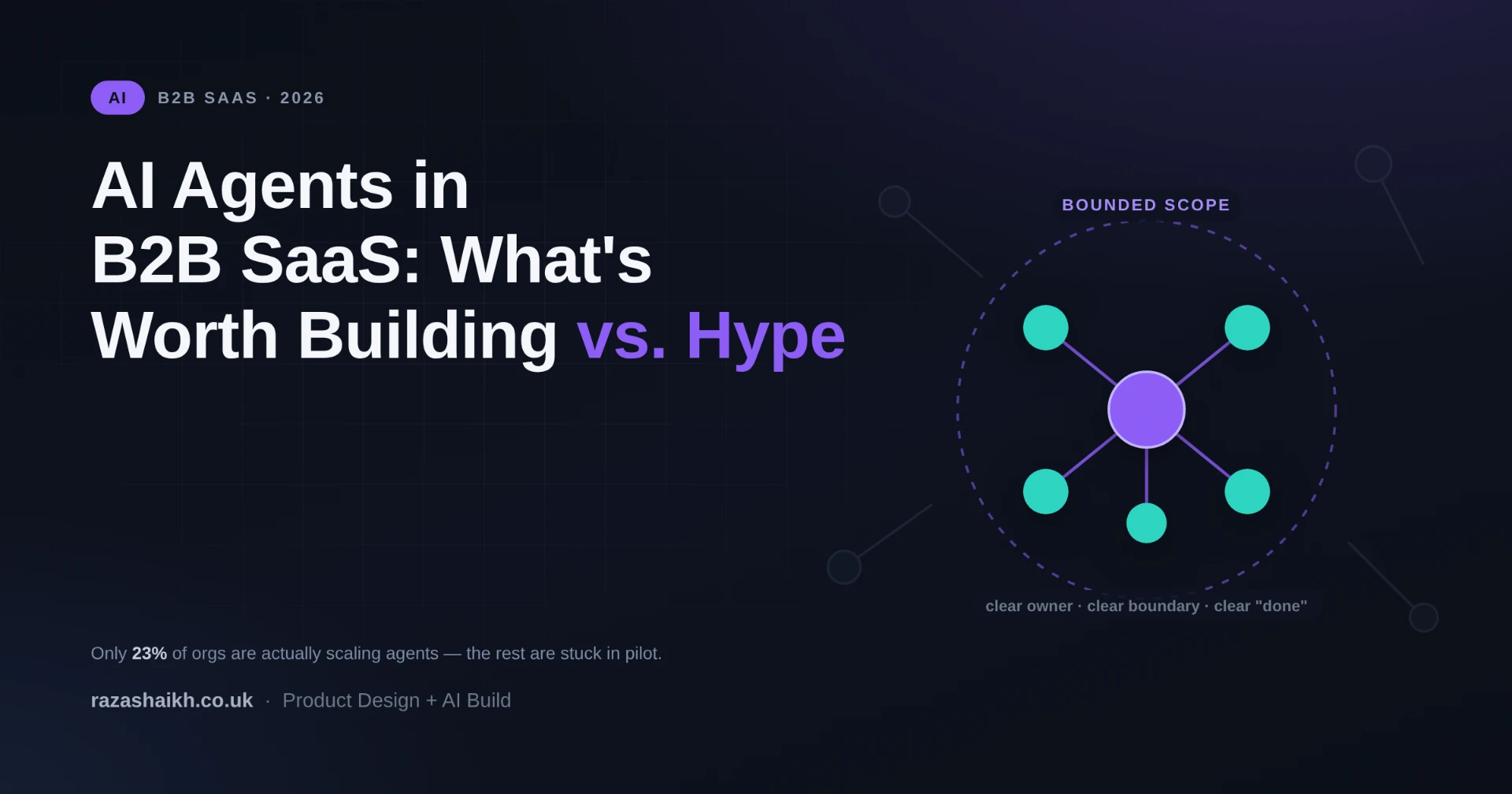
The common thread: a well-instrumented system, a clearly bounded authority, an unambiguous definition of success. None of these require the agent to exercise judgment about something ambiguous. They require it to execute a defined process faster and more consistently than a person would.
Where it stalls, and why
The failure pattern is just as consistent, and it shows up before a model gets involved.
Teams build the agent because it's the roadmap item, then go looking for a metric to justify it afterward — no defined business value before the build starts. Token usage and API calls at production scale can turn a promising demo into a cost line nobody wants to own, especially once the agent hits edge cases needing longer context or retries. With only 21% of companies having mature agent governance, most deployments are one bad decision from a support ticket that becomes a headline; it's worth noting the projection that by 2028, a quarter of enterprise breaches will trace back to AI agent abuse. That's not a reason to avoid agents. It's a reason to treat "who can this agent talk to, and what can it actually do" as a design question rather than an afterthought.
The one people underrate most is ownership. Every deployment actually scaling has a specific, named person accountable for that agent's performance, monitoring, and error handling. Every deployment stuck in pilot purgatory doesn't. An agent without an owner isn't a product. It's an unmonitored process with API access.
A practical filter before you build one
If you're deciding whether a workflow is agent-ready, the questions that matter aren't about the model, they're about the workflow. Is the system instrumented well enough that the agent has reliable signal to act on, not tribal knowledge sitting in someone's head? Is there an unambiguous definition of "done" that doesn't need human interpretation? Can you draw a hard boundary around what the agent is and isn't authorized to do, the way "refund within policy limit" draws a line that "resolve this angry customer" doesn't? And is there a specific person whose job it is to own this agent's failures, not just its launch?
If you can't answer all four cleanly, you don't have an agent-shaped problem yet. You have a roadmap slide with the word "agent" on it. The fix usually isn't more AI, it's narrowing the scope until the four answers are clean, then building the boring, well-bounded version first. The same discipline applies to shipping AI features generally.
The version worth building
The founders getting real value aren't chasing the most impressive agent demo. They found the specific 80% of a workflow that's repetitive, well-defined, and low-risk, handed that to an agent, and left the judgment-heavy 20% with a human who now has time to do it well. It's not a coincidence that the agents currently ranked highest on AigentGallery — Vapi for voice, Parahelp for support, Cardinal for sales outreach — are exactly this shape: one narrow job, done reliably, with a clear line around what it's allowed to touch. None of them pitch themselves as an "autonomous teammate." That's a less exciting pitch. It's also the version still running in eighteen months instead of quietly disappearing from the roadmap next quarter.
Build the boring part first. The impressive part can wait until the boring part works.